A Comprehensive Guide to AI’s Role Across Modern Industries
Artificial Intelligence (AI) is reshaping industries across the globe at an unprecedented pace. What once seemed like a futuristic concept is now deeply integrated into manufacturing, healthcare, finance, logistics, retail, and many other sectors. AI is not only improving efficiency but also redefining how businesses operate, compete, and innovate.
In today’s digital economy, industries generate vast amounts of data. Managing, analyzing, and utilizing this data effectively is critical for success. AI provides the tools to transform raw data into actionable insights, enabling organizations to make smarter decisions, automate processes, and deliver better products and services.
This article explores how AI is used in industry, its applications across different sectors, benefits, challenges, and future potential.
Introduction to AI in Industry
Artificial Intelligence refers to computer systems capable of performing tasks that typically require human intelligence. These include learning from data, recognizing patterns, solving problems, and making decisions.
In industrial settings, AI is used to:
- Automate repetitive tasks
- Optimize operations
- Improve product quality
- Enhance decision-making
Industries are adopting AI to stay competitive, reduce costs, and improve productivity.
Evolution of AI in Industry
Early Automation
Industries initially relied on basic automation systems, such as machines programmed to perform repetitive tasks.
Introduction of Smart Systems
With advancements in computing, industries began using software systems for data management and analysis.
AI-Driven Transformation
Today, AI enables machines to learn, adapt, and make decisions, leading to smarter and more efficient industrial processes.
AI in Manufacturing
Manufacturing is one of the most impacted sectors by AI.
Smart Factories
AI enables the creation of smart factories where machines communicate with each other and operate autonomously.
Predictive Maintenance
AI predicts equipment failures before they occur, reducing downtime and maintenance costs.
Quality Control
AI systems inspect products for defects with high accuracy.
Robotics
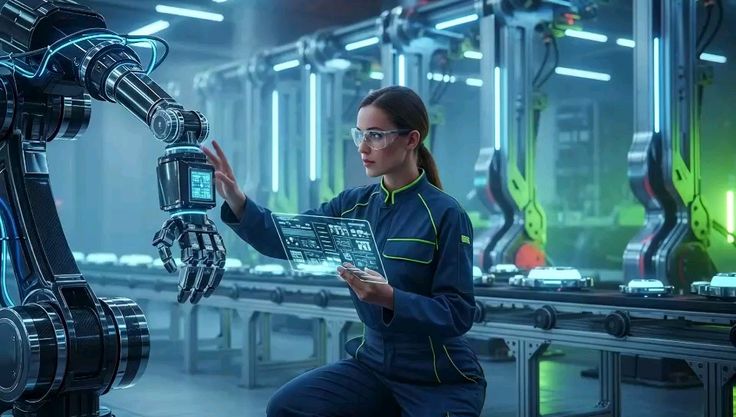
AI-powered robots perform tasks such as assembly, welding, and packaging.
Benefits
- Increased efficiency
- Reduced costs
- Improved product quality
AI in Supply Chain and Logistics
Efficient supply chain management is critical for industries.
Demand Forecasting
AI predicts customer demand, helping businesses manage inventory effectively.
Route Optimization
AI finds the most efficient delivery routes, reducing transportation costs.
Warehouse Automation
AI-powered robots manage inventory and handle goods.
Impact
- Faster delivery
- Reduced operational costs
- Improved customer satisfaction
AI in Healthcare Industry
AI is revolutionizing healthcare.
Diagnostics
AI helps detect diseases early through data analysis.
Treatment Planning
AI suggests personalized treatment plans.
Hospital Management
AI optimizes scheduling and resource allocation.
AI in Finance Industry
Financial institutions use AI extensively.
Fraud Detection
AI identifies suspicious transactions.
Investment Management
AI analyzes market trends and provides investment recommendations.
Customer Service
AI chatbots assist customers with queries.
AI in Retail Industry
Retail businesses use AI to enhance customer experience.
Personalized Recommendations
AI suggests products based on customer preferences.
Inventory Management
AI tracks stock levels and predicts demand.
Pricing Optimization
AI adjusts prices based on market conditions.
AI in Energy and Utilities
AI is improving efficiency in energy management.
Smart Grids
AI optimizes energy distribution.
Predictive Maintenance
AI ensures equipment reliability.
Energy Efficiency
AI reduces energy consumption.
AI in Agriculture Industry
AI is transforming agriculture.
Precision Farming
AI analyzes soil and weather data.
Crop Monitoring
AI detects diseases and pests.
Automation
AI-powered machines assist in planting and harvesting.
AI in Transportation and Automotive Industry
AI is driving innovation in transportation.
Autonomous Vehicles
AI enables self-driving cars.
Traffic Management
AI optimizes traffic flow.
Fleet Management
AI improves logistics and vehicle performance.

AI in Construction Industry
Construction companies are adopting AI.
Project Planning
AI analyzes data to improve planning.
Safety Monitoring
AI detects hazards on construction sites.
Resource Management
AI optimizes material usage.
AI in Telecommunications
AI enhances communication systems.
Network Optimization
AI improves network performance.
Customer Support
AI chatbots handle customer queries.
Predictive Maintenance
AI ensures network reliability.
Benefits of AI in Industry
AI offers numerous advantages.
1. Increased Productivity
AI automates tasks, improving efficiency.
2. Cost Reduction
AI reduces operational costs.
3. Improved Accuracy
AI minimizes errors.
4. Better Decision-Making
AI provides data-driven insights.
5. Innovation
AI enables new products and services.
Challenges of AI in Industry
Despite its benefits, AI presents challenges.
High Implementation Costs
Developing AI systems can be expensive.
Data Privacy Concerns
Handling sensitive data requires strong security.
Skill Gap
There is a shortage of AI-skilled professionals.
Integration Issues
Integrating AI with existing systems can be complex.
Ethical Considerations
AI raises important ethical questions.
Job Displacement
Automation may replace certain jobs.
Bias in AI
AI systems may produce biased outcomes.
Accountability
Responsibility for AI decisions must be defined.
Future of AI in Industry
The future of AI in industry is promising.
Emerging Trends
- AI-powered automation
- Smart factories
- Integration with IoT
- Advanced robotics
Impact
AI will:
- Transform industries
- Improve efficiency
- Create new opportunities
AI and Industry 4.0
AI is a key component of Industry 4.0.
Features
- Automation
- Data exchange
- Smart systems
Role of AI
AI enables intelligent decision-making and process optimization.
Opportunities in AI for Businesses
Startups
AI offers opportunities for innovation.
SMEs
Small businesses can use AI to compete with larger companies.
Enterprises
Large organizations use AI for large-scale operations.
How Businesses Can Implement AI
Identify Needs
Determine where AI can add value.
Choose Tools
Select appropriate AI technologies.
Train Staff
Develop AI skills within the organization.
Monitor Performance
Evaluate AI system effectiveness.
Conclusion
Artificial Intelligence is transforming industries by improving efficiency, reducing costs, and enabling innovation. From manufacturing and healthcare to finance and retail, AI is revolutionizing how businesses operate.
While challenges such as cost, ethics, and data privacy remain, the benefits of AI far outweigh the risks. As technology continues to evolve, AI will play an even greater role in shaping the future of industry.
Organizations that adopt AI will be better positioned to succeed in the competitive global market, making AI not just a technological advancement but a strategic necessity for the future.
If you want, I can next:
- Add SEO optimization (title, meta, keywords)
- Create a featured image/banner
- Or design a full blog layout for this article 🏭🚀
No responses yet